
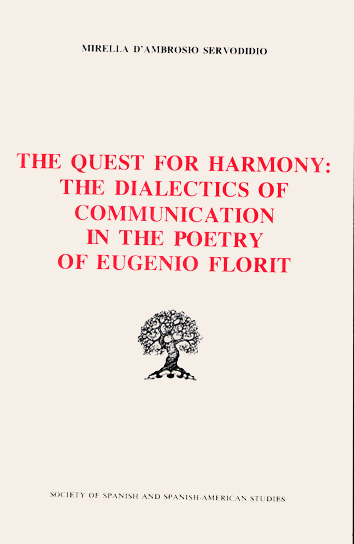
The Quest for Harmony: The Dialectics of Communication in the Poetry of Eugenio Florit ∥ Servodidio, M. D'Ambrosio
-----------------------------------
ISBN13: 9780892950089
-----------------------------------
サイズ: 14 x 21 x 1.5 cm
-----------------------------------
頁 数: xi+170 pgs.
-----------------------------------
装 丁: paper cover
-----------------------------------
出版社: Society of Spanish and Spanish-American Studies
-----------------------------------
発行年: 1979
-----------------------------------
発行地: Boulder
-----------------------------------
双書名: S.S.S.A.S.
-----------------------------------
書籍状態: 経年変化による酸性紙表紙&頁の軽度な変色
追加情報: ※ 詳細PDFリンク
本書は、20世紀を代表するスペイン系アメリカ詩人エウヘニオ・フロリットの詩業を包括的に読み解く研究書です。著者M・ダンブロージオ・セルボディディオは、フロリットの詩作品において、実存的にせよプラトン的にせよ神秘的あるいは歴史的にせよ、「両極性」という観念が全作品を貫く根源的な原理であると論じます。古典主義とロマン主義、形式主義と表現主義との弁証法的対立は、詩人の内面に巣くう二元性の外的な現れにすぎず、矛盾の糸から織りなされたその詩人の本性の一方で、その著作には共通の根、すなわちこれらの差異を解消・和解、あるいは耐え忍ぶための調和への探求が見出されると著者は指摘します。純粋詩の形式主義、詩人の美的救済の思想、感覚がとらえた世界を再構成する想像力と知性の理想化作用(『トロピコ』に見られるように)、抽象化と距離化による情熱の制御(エロスの主題)、生き方としての死という不関与の選択(タナトスの主題)、追憶の技法による過去の想像的改訂、そして恩恵に満ちた自然、理性の法則、信仰の教えの称揚に至るまで、フロリットが行使した多層的な統御のあり方が丹念に検証されています。書籍の言語:英語 (SBC: 105759)
[対象地域、年代、研究分野]
キューバを対象地域とし、20世紀のエウヘニオ・フロリットの活動期を分析対象とする本書は、ラテンアメリカ詩研究、比較文学研究、詩学・美学研究の分野に位置づけられます。ラテンアメリカ詩研究の専門家をはじめ、比較文学研究者、詩学・美学研究者を対象としています。
※ タイトルページ、目次、プロローグなどは「追加情報」のPDFをご参照下さい。
Description:
For the past few decades, Eugenia Florit has been considered an important Spanish-American poet because of the intrinsic value of his poetry, a corpus that has served as a leading testimony of the many configurations poetry has adopted during the twentieth century. In her study of Florits poetry, Professor Servodidio provides a cohesive view of his poetic production. Her basic premise is that in Eugenio Florit’s poetry, the notion of polarity - whether understood existentially, Platonically, mystically or historically - is a seminal one, governing his entire opus.
The dialectical opposition between Classicism and Romanticism, formalism and expressionism, then, is merely the external manifestation of a duality which besieges the poet from within. Yet, while the poet’s nature is woven from a skein of contradictions, his writings exhibit a common root: the quest for a harmony through which these differences may be resolved, reconciledor-endured. To this end, as this study shows, Florit has exerted distinct levels of control: the formalism of ‘pure’ poetry, the poet’s aesthetic of Salvation, the idealizing activity of the imagination and intellect which reshapes the world depicted by the senses - as in Tr6pico; the tempering of passion through abstraction, distancing and indirection - studied under Eros; the choice of noninvolvement of death-as-a-way-of-life, examined under thanatos; the imaginative revision of past of an art of recollection and, most centrally, the exaitation of a beneficient nature, the laws of reason. and the lessons of faith.
The poet, indeed, experiences periods of integration and stability when he knows himself whole. Yet, what harmonious unity Florit encounters, the synthesis of opposites it presupposes is, at best, a fragile state. The study demonstrates,, that in the poets temporal existence, the laws of polarity and contradiction cannot be permanently abrogated.
TABLE OF CONTENTS:
I. Introduction......1
II. A Poetry of outwardness......7
The Poet as Exegete: A Doctrine of Aesthetic Salvation......7
Tropico: The Delineation of a Cosmos......12
III. A Poetry of Inwardness: The Anatomy of Disquiet......23
Eros as the Tendance of the Body......26
Thanatos......35
An Iconography of Disquiet......51
IV. The Struggle for Serenity: Angles of Vision......81
An Art of Recollection......81
Disquiet Quelled Through Art......93
Nature as Permanence: The Poet in Harmony......102
Eros as the Tendance of toe Soul......115
V. Conclusion......161
Bibliography......167
-
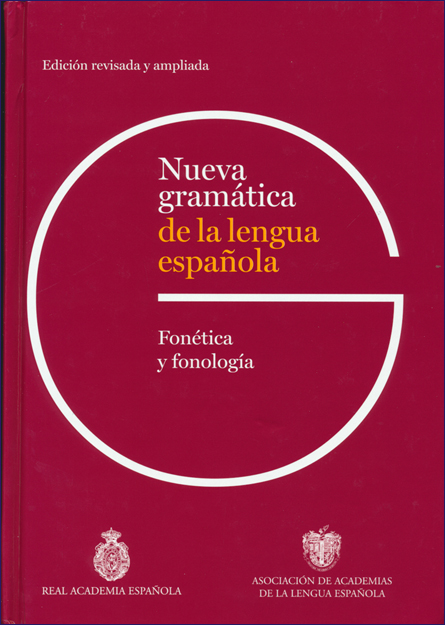
RAE(スペイン王立アカデミー)とASALE(スペイン語アカデミー協会)が共同編集した改定新版「アカデミア最新スペイン語文法」シリーズ(既刊3巻)。2025年10月に刊行された本書は、その第4巻(最終巻)です。 2011年版の 555頁から 新版は 700頁余と大幅に改訂増補 !!
※ スペイン語の音声を体系的に理解するための資料として、研究者、教育関係者、上級学習者に不可欠であり、大学図書館・研究室にも必須の一冊です。
※ 大幅な改訂と更新: 旧版以降に進んだ最新の研究成果、特に言語の「バリエーション」に関する知見を全面的に反映。技術の進歩を活用し、内容の理解を助けるための工夫が凝らされています。
※ 具体的な革新点: 知覚音声学への配慮、第1章の全面的な書き直し、イントネーションを扱う第10章の大幅な改訂、QRコードによる発音サンプルの導入、補足的な参考文献の追加など。- Nueva gramática de la lengua española: Fonética y fonologia ∥ R.A.E.
- ¥17,380
-

※ スペイン王立アカデミーとASALE(スペイン語アカデミー協会)が共同編纂した、スペイン語の語彙の歴史を包括的に記録する辞書。語源・形態・意味の変化を詳細に解説しています。
※ DHLE(スペイン語歴史辞典)プロジェクトは現代のデジタル技術と国際的な共同作業体制を駆使して進行中の画期的な取り組み。
※ 10巻本・合計2万ページ超となる今回の紙書籍版(印刷版)は本プロジェクトの記念碑的な出版物。図書館・研究室の重要資料として長期保存の価値が高い文献になります。今後の更新はデジタル版に移行する見込みで、今回の書籍版は将来入手困難になることが予想されます。
※ 全10巻のうち、第1~3巻は現在では入手困難な1960年~1996年版(a-apasanca、b-bajoca)の復刻版です。過去の貴重な学術的成果であり、一次史料としての価値が高いものです。
※ 第4~10巻は2005年以降に進められたデジタル版DHLEから代表的な項目を抜粋して構成。
収録内容はスペイン語語彙史研究の最新成果を反映し厳選されています。- Diccionario histórico de la lengua española. in 10 vols. ∥ R.A.E.
- ¥178,200
-
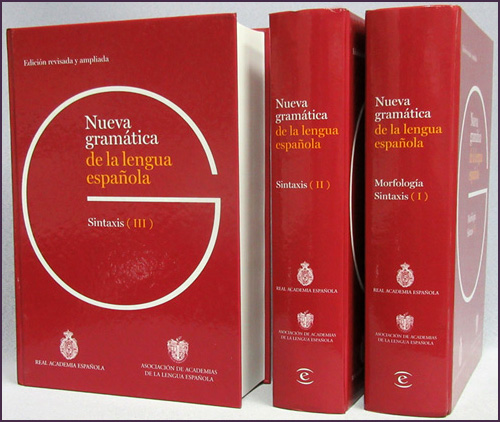
好評発売中!!
第2版 増補改訂版3巻本 「アカデミア最新スペイン語文法」。2009年に2巻本として出版されてから16年、さらに広く深く、スペイン語圏全体のスペイン語を総合的に扱うスペイン語文法書の決定版です!
本書はスペイン王立アカデミー(RAE)とASALE が共同で編纂した最新のスペイン語文法を、より精緻に再構成した改訂増補版であり、形態論から統語論に至るまで、スペイン語の構造を体系的かつ包括的に示す研究書です。従来版よりも内容説明が充実し、分析の明確化、現象の地理的・社会的分布に関する情報の拡充、さらに学習者・研究者双方に配慮した丁寧な解説が加えられています。全3巻・約5000頁に及ぶ大部の構成は、汎ヒスパニック的視点を重視し、スペイン語圏全体の多様性を踏まえた記述を特徴としています。記述文法と規範文法の両面を兼ね備え、学術研究・高度教育機関において必携の基礎資料となる一冊です。- Nueva gramática de la lengua española - Edicion revisada y ampliada in 3 vols. ∥ Real Academia Española
- ¥52,140